
Achievements to Date
Inspiration for the formation of the West Kent Downs Countryside Trust came from CAMS (Cobham Ashenbank Management Scheme).
From the onset in 2000 we worked close with CAMS leading up to the restoration of the Darnley Mausoleum and Cobham Heritage Park prior to the National Trust taking over.
Today we benefit from our association with the National Trust Cobham Heritage Park and with Plantife’s Ranscombe Farm Reserve, originally as part of their Management Commmittee, and now continue to support each other as neighbouring partners.
Our set-up years were busy with holding workshops and consultations with local residents to determine the form the Trust should take and what its activities should be. By this time the issues of fly tipping, car dumping, joy-riding and forest fires was at its height, radiating out from the Leisure Plot area.
Gates and boundary fences were erected to restrict access and were moderately successful, although they attracted vandalism and for a few more years motor-bikes remained a problem.
Milestones
– 2003 Onwards –
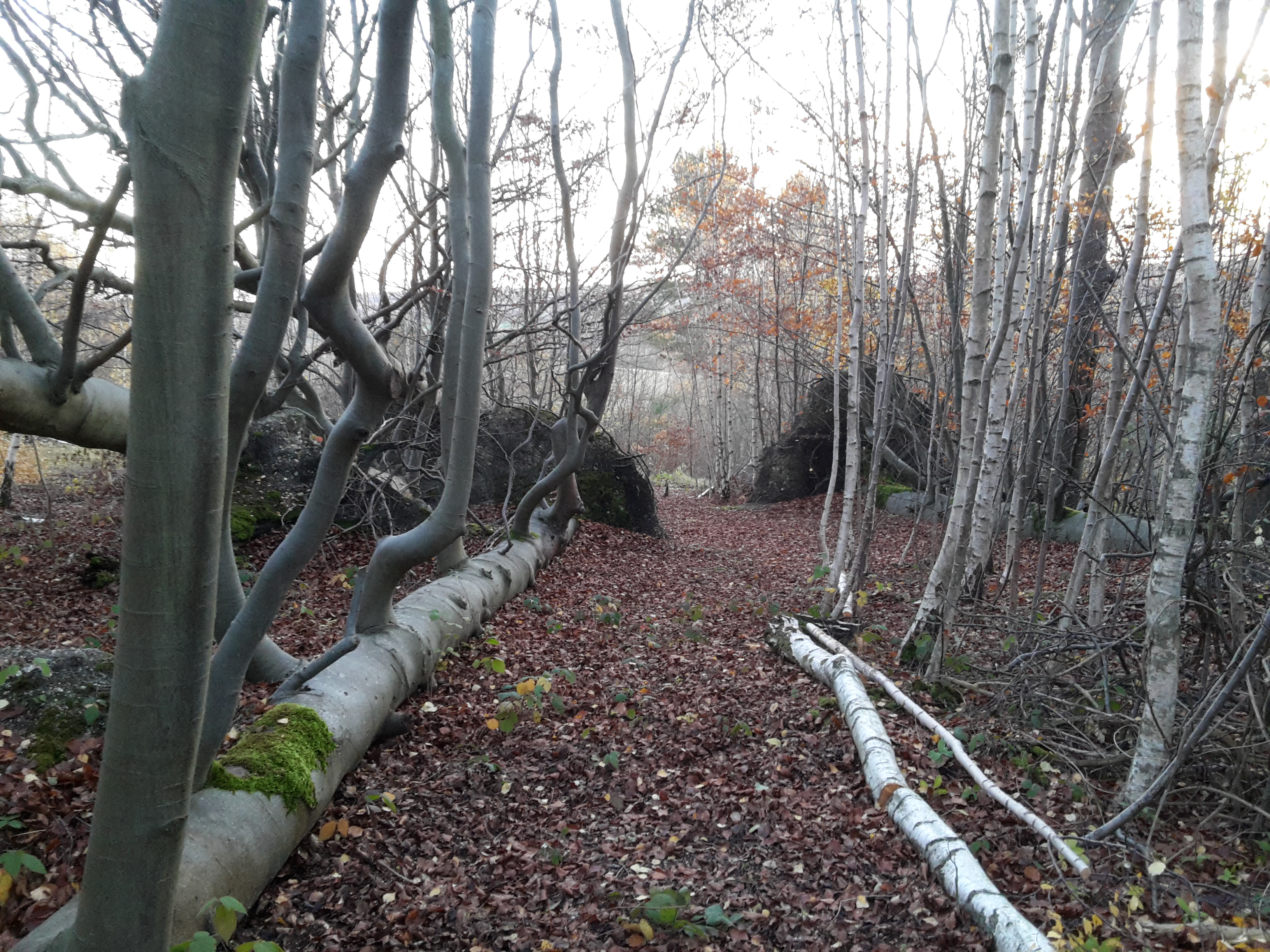
Our volunteers searched all the woods from Cobham to Ranscombe, mapping the exact locations of abandoned and burnt vehicles. 103 wrecks were located with 9 found in the Plotlands which contractors subsequently removed.
A Feasibility Study and Business Plan was produced, aided by a grant from The Channel Tunnel Rail Link Countryside Initiative and our fund-raising.
We concentrated on tracing plot owners and holding events to promote the Trust. We raised funds for plot purchase, acquired plots and made progress on clearing and maintaining access.
– 2006 –
We acquired our first six plots. This was the start of continuous hands-on conservation work by our member volunteers. By January 2012 we had acquired a further 23 plots.
– 2010 –
We created a Heritage Trail leaflet and commissioned a wildlife-themed bench to be carved by Steve Porchmouth, and its installation provided a focal point. The project was carried out on behalf of Cuxton Parish Council as part of the Valley of Visions Community Trails initiative.
– 2013 –
Orchard Planning Consent to remove the failing fruit trees in the Orchard on Warren Plain to restore and conserve the natural Chalk Grassland. Access clearance of wind-blown trees was completed.
– 2014 –
Continued Chalk Grassland Restoration on the Orchard Site, including a Kent Field Club study day, took place. Botanists recorded 43 scarce Chalk Grassland plant species and a rare lichen.
– 2015 –
Plot Owner research survey commissioned with Natural England, we gained plots from 9 more owners. We had initial meetings for the new Management Plan with Natural England and Forestry Commission, to assess woodland/habitat conditions and prepare a structured Woodland Management Plan.
– 2016 –
We gained the Government’s Rural Payments Agency registration and the County / Parish Holding Number (CPH) as the registered Holder for the entire Plotland area, which amounts to 45.88 hectares (113.47 acres). We were subsequently awarded a grant from the Forestry Commission for a contribution towards funding our new Woodland Management Plan prepared by our Arborologist, Curtis Barkel from Sylvanarb.
Natural England and the Forestry Commission approved our 10 Management Plan and Felling License.
– 2018 –
A demonstration of logging using a heavy horse to extract timber was given by Frankie Woodgate, with refreshments provided by a Lottery-funded charity called Old Chalk New Downs (OCND). We hosted a Cycle Trail Treasure Hunt in the Plotlands and two walks to explore the local fungi.
Chalk Grassland Restoration – We formed a partnership with OCND whose mission was to restore a rare habitat called chalk grassland. This exists where there is a thin layer of soil over chalk deposits and specific plants have evolved to cope with the dry, nutrient-poor habitat. There is an area of chalk grassland in the woodland which had previously been developed as an orchard. This meant that copious amounts of fertiliser had been used to make the trees grow. Only the grass grew well and out-competed the chalk grassland.
– 2019 –
OCND funded fencing around the orchard and installation of farm gates to allow us to conservation-graze cattle there. We have continued to do that with good results – wildflower surveys show that the variety and extent of chalk grassland plants is increasing slowly, year on year. Although OCND’s funding has now ended, we have decided to continue the chalk grassland project using our funding.
Surveys of the bats present in the ancient trees in the Plotlands were carried out.
A cycle trail Treasure Hunt was hosted in the Plotlands.
Sites suitable for Forest Schools and Scout camping were prepared.
– 2020 –
Trustees had previously noticed that many of the plots in the woodland were owned by a company that had been wound up in 1985. Investigation revealed that the plots would now belong to the Bona Vacantia Department of the Crown Office (BVD). Following extensive representations by local officials and Members of Parliament, BVD agreed to sell the 42 plots to us at a reasonable price.
There was a wrecked garage in an area of the orchard and the debris was a dangerous eyesore. With funding from OCND and the consent of Natural England, we removed the metal and concrete wreckage and then constructed a 9m x 6m pond in the resulting hole.
It is important to note that in Western Europe we have exterminated 60% to 80% of our flying insects in the past 40 years. This matters a great deal since one service they performed for us was to pollinate most of the fruit trees and other crops.
Many insects breed in or near water so it is important to provide suitable sites for this to happen, as well as improving the diversity of wildlife in the woodland. Sites near the centre of Cobham Woods are protected from farmland spraying by the surrounding trees.
Cuxton Beavers planted native tree saplings in a suitable area of the Plotlands.
– 2021 –
The pond filled with rainwater over the winter of 2021 and was stocked with native plants in the following Spring. The pond and its margins are being colonised by local flora and fauna including a pair of Southern Darter dragonflies.
Nine acres of sweet chestnut coppice were acquired from BVD. The trees had been left for too long and required felling. A plan was agreed with the Forestry Commission to fell them in a patchwork layout over a period of six years. This would allow time for regrowth of the felled trees which would leave adjacent intact habitat for the insects, birds and mammals to move into. Coppicing has been carried out in Britain for at least 5000 years and our local wildlife is well-adapted to it. It is a brutal-looking process but is necessary to maintain continuing healthy development and the cut stools soon recover. The cut timber is used to make post and rail fencing so there is a net carbon-fixing gain.
On-Going Achievements and Tasks
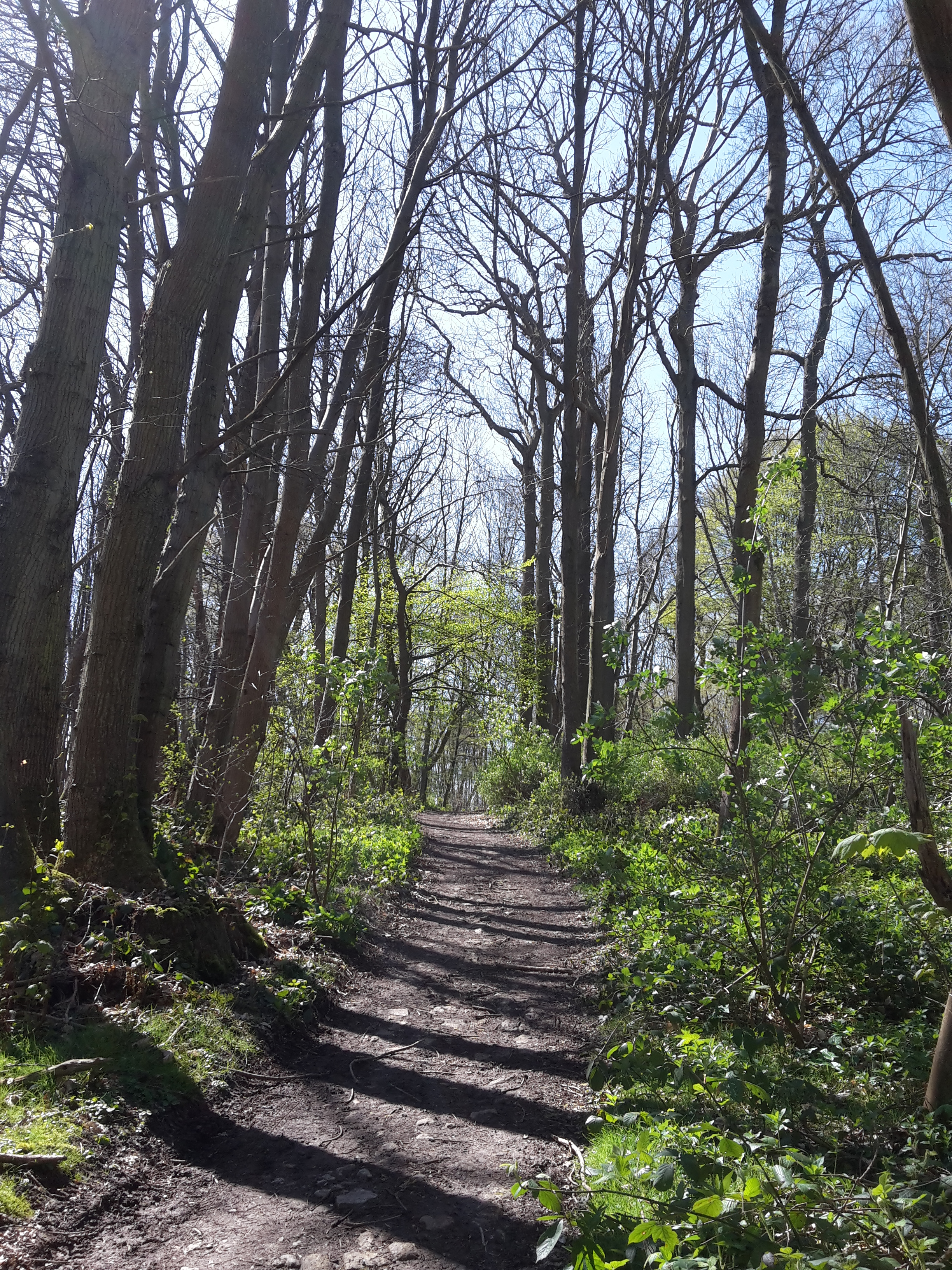
- Habitat Restoration and Improvement
- Commenced work under the New management Plan.
- Continued to acquire plots and care-take the area as one complete woodland.
- Carry out necessary conservation felling of sycamore.
- Implemented coppicing regimes and forestry thinning.
- Eradicated some of the rhododendron growth.
- Carrying out wild life surveys and monitoring activity.
- Provide and install some nest-boxes and bat boxes.
- Planted native tree seedlings, protect native re-growth, and introduce deer exclusion zones when necessary.
- Reinstating access. Maintaining track-ways. Regularly inspect and removing fallen and hazardous trees.
- Providing opportunities for community involvement and countryside education through volunteering and events.
- Thinning of sycamores, creation of glades and protection of regeneration. Tree planting with oak, beech, hornbeam, ash, hazel, wild cherry, aspen and various pollinators.
- Halo felling around keystone species such as oak.
- Removal of rhododendron / Veteran tree care.
- Track maintenance and clearance.
- Following the successful construction of the orchard pond we plan to use the same techniques to construct five more ponds in various locations in the Plotlands which will further improve the invertebrate population. Funding has been agreed by Lower Thames Crossing. The ponds will be sited to suit the connective corridors to other local conservation sites.
- We shall be embarking on a new project with Natural England to expand the chalk grassland conservation area to adjacent plots.
A WordPress.com site
 West Kent Downs Countryside Trust